
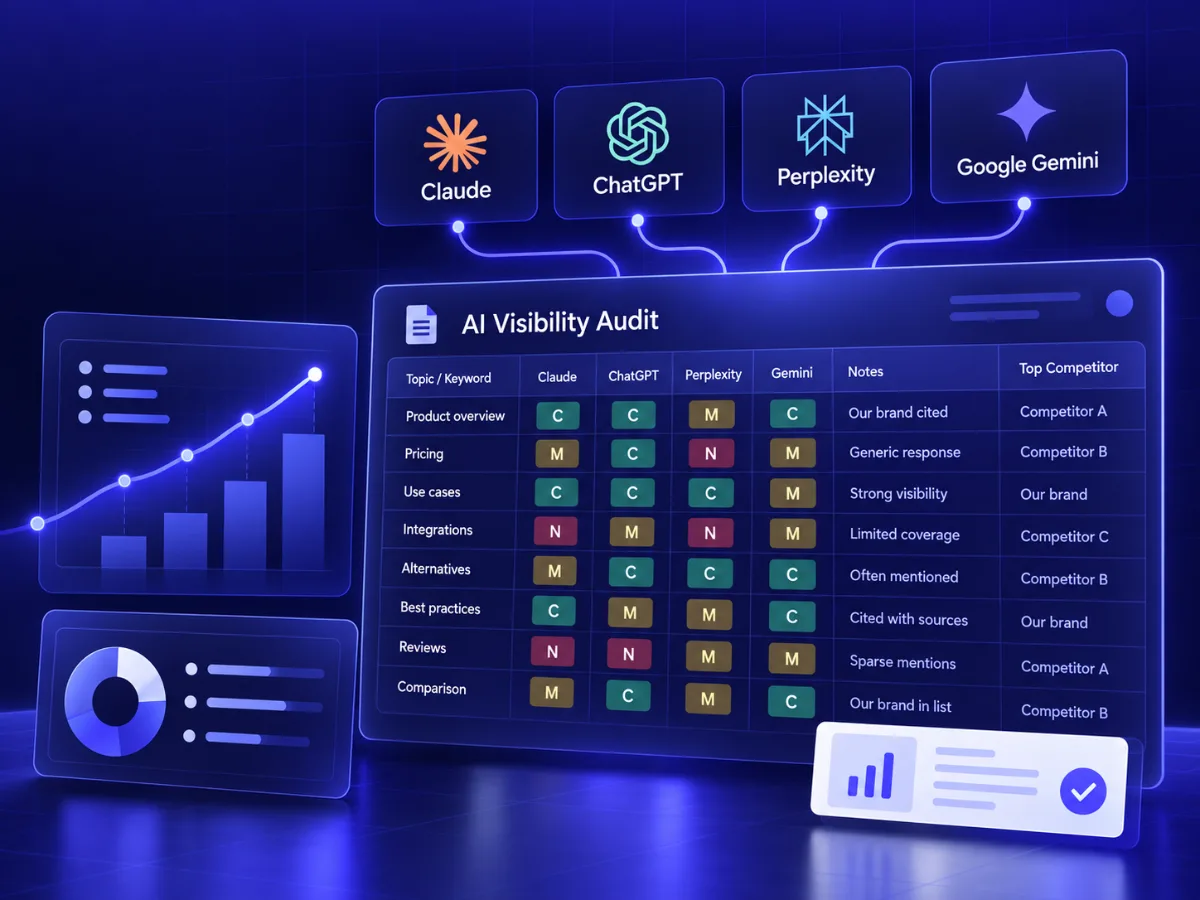
A B2B AI visibility check tells you whether ChatGPT, Perplexity, Gemini and Google AI Overviews name your brand when buyers ask for vendors in your category. It takes 30 minutes, a spreadsheet and free accounts. This is the manual audit I run before any AI visibility engagement, and most teams that hire me have never done it.
Buyers have already moved. In G2’s March 2026 survey of 1,076 B2B software buyers, 51% said they start research in an AI chatbot more often than in Google. Marketing teams have not followed: only 27% of 600 marketers in a Page One Power survey track AI visibility consistently, and 12% did not know it could be tracked.
One finding changed how I run this audit. SparkToro and Gumshoe ran the same 12 prompts 2,961 times across ChatGPT, Claude and Google’s AI features, and got the same list of brands less than once in 100 runs. A single pass is a snapshot, not a ranking. The method below accounts for that.
Why this matters before you spend anything
Google Analytics cannot see AI visibility. It shows visits from chatgpt.com or perplexity.ai when someone clicks, and nothing when an AI answer names a competitor and the buyer never visits you. Most teams I speak to assume their organic traffic tells them how they are doing in search. For AI answers, it tells them nothing.
Many prompts do not name any brand. A BrightEdge analysis of thousands of ChatGPT prompts in August 2025 found 44% contained zero brand mentions, and even 25% of “best” queries named no brand. That is why this audit uses queries that ask the AI to name vendors. Informational queries will give you a zero that means nothing.
Every AI SEO strategy I run starts with this baseline. It shows which queries and engines already name you, which ones name competitors instead, and where the work needs to go. Without it, you cannot tell later whether anything you did moved the result. Before you buy a tool, hire a consultant or start an AI visibility project, get a baseline. It costs you 30 minutes.
What you will need
- A spreadsheet: Google Sheets, Excel or Airtable
- Access to ChatGPT, Perplexity, Gemini and Google; free tiers work
- 30 minutes without interruptions
- An honest list of the queries your buyers run
No AI visibility subscription, no Semrush licence, no Ahrefs API. Paid tracking can come later. For a first baseline, the manual audit gives you most of what you need to decide.
Step 1: Build your query set (5 minutes)
Most teams skip this step and type queries off the top of their heads. That produces a useless audit.
Write 10 queries that real buyers type. Not what you wish they would type, and not marketing-team guesses. Use the questions your sales team hears on discovery calls, split into three groups. The examples below are for an MSSP.
Category-level queries, 4 of the 10. A buyer building a shortlist does not know your brand yet and is asking the AI to name vendors:
- Best MSSP for financial services in North America
- Top managed SOC providers for mid-market companies
- Best MSSPs with SOC 2 compliance for SaaS companies
- Which MSSP is best for healthcare HIPAA requirements
Use-case queries, 4 of the 10. A buyer has a specific problem and wants a vendor that solves it:
- Best managed detection and response for detecting ransomware early
- Vendors that offer 24/7 SOC monitoring for Canadian businesses
- MSSPs that provide compliance reporting for PCI-DSS audits
- Managed security providers that support Microsoft E5 environments
Brand-direct queries, 2 of the 10. A buyer has heard your name and wants to check you out:
- Is [Your Company] a good choice for managed security services
- [Your Company] vs [Competitor]
Put the 10 queries in the first column of your spreadsheet. Label the next four columns ChatGPT, Perplexity, Gemini and Google AI Overviews. That is your audit grid.
If you cannot come up with 10 queries that feel real, your positioning is too vague. Spend 10 minutes with your sales team first. Their discovery call notes are the best source for this list.
Step 2: Run your queries through four AI engines (15 minutes)
This is the bulk of the audit. Paste each query into each platform and record what happens, using the codes in the template further down: C for cited, M for mentioned, N for not mentioned.
ChatGPT
Open a Temporary Chat so your own history does not shape the answer; OpenAI says temporary chats do not access memories or previous conversations. Make sure search is on. For each of the 10 queries, record:
- Whether your brand is named at all
- If named, whether it links to your domain as a source or is only mentioned
- Which competitors are named
- How many vendors the answer names in total
A citation means ChatGPT used your page as a source and links to it. A mention means it knows your brand but did not use your site to back the answer.
Perplexity
Run the same 10 queries in Perplexity. It shows numbered source links after each claim, which makes it the easiest engine to audit. For each query, record:
- Whether your brand is named
- Whether your domain is among the sources
- Which competitor domains are among the sources
- Which third-party sources are cited: review sites, publications, Reddit threads
Perplexity usually cites more sources per answer than ChatGPT. Analyze AI’s comparison of 5,755 matched answers in August 2026 counted 6.71 citations per Perplexity answer against 3.60 for ChatGPT. Do not expect one engine to predict the other: Profound found only 11% of cited domains appear in both.
Gemini
Open the Gemini app and run the same 10 queries. Gemini draws on Google’s index and Knowledge Graph, so entity signals such as a consistent company name, About page and Wikidata entry count for more here. For each answer, record:
- Whether your brand is named
- Which sources appear below the answer
- Whether the answer describes you correctly or mixes you up with another company
Google’s other AI features matter here too. Alphabet reported in July 2026 that AI Mode had passed 1 billion monthly users. If you have five more minutes, add AI Mode as a fifth column.
Google AI Overviews
Open an incognito window to cut personalisation, and search each query in Google. For each one, record:
- Whether an AI Overview appears at all
- Whether your brand is named in the Overview
- Whether your domain is in the cited sources
- Which competitors appear
Not every query triggers an Overview, and the rate moves. Semrush’s study of more than 10 million keywords measured AI Overviews on 6.49% of queries in January 2025, 24.61% at the July 2025 peak, and 15.69% in November 2025. If your category queries show no Overview, record that. It is still data.
Overviews change fast, too. Ahrefs tracked 43,000 keywords and found the Overview content changed in about 70% of back-to-back checks, with only 54.5% of cited URLs carrying over. The meaning stayed stable even when the wording and sources moved.
Step 3: Score what you found (5 minutes)
You now have 40 data points: 10 queries across 4 engines. Turn them into four scores.
Visibility Score
Count the cells marked C or M, divide by 40, and multiply by 100. These are the bands I use with clients:
| Score | What it means |
|---|---|
| 0 to 25% | Mostly invisible. A starting baseline, not a verdict |
| 25 to 50% | Partial. You appear for some queries, not consistently |
| 50 to 75% | Strong. Named across most buyer-intent queries |
| 75 to 100% | Category leader. Rare |
The bottom band is where I started too. When I ran a 90-query baseline on my own site in summer 2026, across ChatGPT, Perplexity and Claude, it scored 0 of 90 before any AEO work. A zero is a starting point you can measure against, not a judgement.
Citation Quality Score
Of the cells where you appear, count how many are C rather than M. A high share of citations means AI engines trust your pages enough to use them as sources. A high share of mentions means the engines know your name but go elsewhere for proof. That is a content structure and entity problem, not a visibility problem.
Knowing your name is not guaranteed either. When Discovered Labs tested 1,000 public B2B SaaS brands against AI models before any web search, the models failed to recall between 21.5% (GPT-5.6 Luna) and 60.2% (Gemma 1) of them.
Competitor Gap
For each query where you are absent, note which competitors are named. Count the three that appear most often. These are the companies you are losing to in AI answers, and they are often not the ones you track in Google. I regularly see clients whose Google competitors and AI competitors are two different lists.
Platform Fragmentation
Compare your scores engine by engine. Each engine leans on different sources: in Profound’s analysis of 680 million citations, Wikipedia made up 47.9% of ChatGPT’s top 10 cited sources, and Reddit made up 46.7% of Perplexity’s.
| Pattern | Likely cause |
|---|---|
| Strong on Perplexity, weak on ChatGPT | Community presence carries you; encyclopedic and entity sources are thin |
| Strong on ChatGPT, weak on Perplexity | Encyclopedic presence carries you; Reddit and review-site presence is thin |
| Strong on Gemini and AI Overviews only | Google rankings do the work; third-party signals are thin |
| Weak on all four | A full AI visibility gap, and the most common pattern I see |
Step 4: Interpret and decide what to do (5 minutes)
Most results fall into one of four outcomes.
Low visibility, high-quality citations where they appear
You are absent most of the time, but when an engine names you, it links to your site. This is a volume problem. You need more places that mention you: review platform profiles, Reddit threads, trade press and industry publications.
Decent visibility, mostly mentions without citations
The engines know you but do not treat your site as a source. This is an entity and content structure problem. Fix it with clear page hierarchies, Organization schema, and a consistent entity across Wikidata, Crunchbase, LinkedIn and your About page.
Strong on one platform, absent on others
You have built for one engine’s preferred sources without meaning to. Use the fragmentation table above to work on the weak engines.
Weak everywhere, competitors named in every query
You are losing shortlist places you did not know you were competing for. This needs a full programme: entity audit, schema, earned mentions on relevant sites, and ongoing tracking.
When to upgrade from manual to automated
Monthly manual audits work for most B2B teams starting out. Upgrade to a paid tool when one of these is true:
- You need to track more than 30 queries across several competitors
- You want to know how AI describes your brand, and whether that description is accurate
- You need weekly or daily tracking
- You need dashboards for other teams
- You have moved past the baseline and are measuring active optimisation work
Paid tools solve a volatility problem a manual pass cannot: they run each prompt many times. In a SparkToro follow-up test of 994 answers to headphone prompts, the top brands still appeared in 55% to 77% of them, so presence across many runs is a fair measure even when the exact list changes. Entry pricing, checked on each vendor’s own page in October 2026:
| Tool | Cheapest paid plan | What it includes |
|---|---|---|
| Otterly.AI Lite | $29 a month | 15 prompts tracked daily on ChatGPT, AI Overviews, Perplexity and Copilot |
| Peec AI Starter | EUR 89 a month | 50 prompts on 3 engines |
| Semrush AI Visibility Toolkit | $99 a month | 25 prompts, including Google AI Mode and ChatGPT |
| Ahrefs Brand Radar | From $199 a month | Standalone or add-on, with paid custom prompt packs |
| Scrunch Starter | $300 a month | 350 custom prompts across ChatGPT, Claude, Gemini, Perplexity, AI Mode, AI Overviews and Meta |
Profound does not publish a self-serve price. Pay for a tool when the manual process becomes the bottleneck, not before you have one manual baseline.
For Copilot, you do not need a tool at all. Microsoft’s AI Performance report in Bing Webmaster Tools counts how often your pages are cited across Copilot and Bing’s AI summaries. For one taxation SaaS client, it recorded 45.2K citations over the six months to October 2026. Google Search Console includes AI Overview and AI Mode clicks in its Web search totals but does not break them out.
The results sheet template
Ten rows for queries, four columns for engines, and a notes column for competitors.
| Query | ChatGPT | Perplexity | Gemini | Google AIO | Notes |
|---|---|---|---|---|---|
| 1. Category query | C/M/N | C/M/N | C/M/N | C/M/N | Competitors named |
| 2. Category query | C/M/N | C/M/N | C/M/N | C/M/N | |
| 3. Category query | C/M/N | C/M/N | C/M/N | C/M/N | |
| 4. Category query | C/M/N | C/M/N | C/M/N | C/M/N | |
| 5. Use-case query | C/M/N | C/M/N | C/M/N | C/M/N | |
| 6. Use-case query | C/M/N | C/M/N | C/M/N | C/M/N | |
| 7. Use-case query | C/M/N | C/M/N | C/M/N | C/M/N | |
| 8. Use-case query | C/M/N | C/M/N | C/M/N | C/M/N | |
| 9. Brand-direct query | C/M/N | C/M/N | C/M/N | C/M/N | |
| 10. Brand-direct query | C/M/N | C/M/N | C/M/N | C/M/N |
C means cited, with a link to your domain. M means mentioned by name but not linked as a source. N means not mentioned. Below the grid, add up the C cells and the M cells, calculate the Visibility Score as (C plus M) divided by 40, and list the three competitors named most often. That is your baseline.
What to do after the audit
Repeat it monthly with the same 10 queries, the same engines and the same sheet, so you can score the change. Answers drift run to run, so on the monthly repeat, run the four category queries three times each and count yourself present if you appear in at least two of the three runs.
Share the results. Your sales team will spot gaps you missed, customer success will know which buyer questions matter most, and your content team will know what to write next.
Then decide whether the gap is worth fixing. If you are invisible everywhere and your buyers research in AI tools, it is. If you only have a gap on one engine, that is a smaller piece of work. For the wider research behind this audit, see my AI SEO statistics for B2B, and for a worked example in one category, the cybersecurity SEO implementation guide. If you would rather I run this check for you, book a consult.